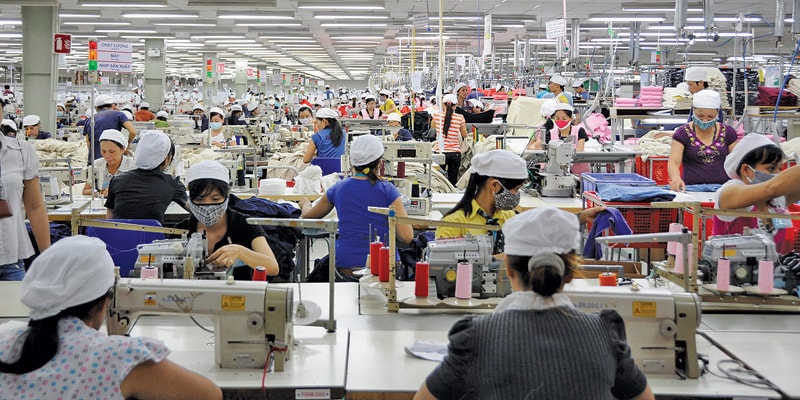
 Vietnam’s rise as a garment hub is a direct outcome of a combination of factors. Political stability, skilled and educated workforce, excellent infrastructure like sea ports, international airports and modern highways is how Robert Nicholson, Chief Representative of More UK Ltd. in Vietnam, describes shaping up of the country’s apparel sector, which is strongly emerging as the clear leader in low-cost manufacturing and sourcing, accounting for almost 25 per cent of the country’s total GDP.
Sensing the vast opportunities that the sector holds, Vietnam has taken a giant leap from CMT operations till recently, to offering FOBs now. “Woven continues to hold sway in Vietnam although knit is also coming up strongly. The country is very strong in ladies’ garments and outerwear, and also offers specialized items like sportswear, workwear, down jackets and skiwear…

Lingerie, swimwear, men’s casual and formal shirts and trousers are also emerging strongly being manufactured in substantial quantities now.” There are also many fully vertically-integrated denim factories with washing facilities in the country, maintains Robert (popularly known as Bob), a Scotsman married to a Vietnamese national, who has two-decade-long association with the country’s apparel industry during which he helped build numerous companies, bring in new business for them and help develop the skill-set of the local workforce to international standards.
“Yes there still are many expats like Sri Lankans, Indians, Filipinos, Koreans Japanese, Europeans and Americans, but their number is much less now. Forward-thinking companies have invested in in-house training and brought in the expats to teach the locals; some companies even send their staff overseas for further training.
The Government has also invested in good technical colleges to train people in different domains of garment manufacturing,” says Robert about the country’s mostly English-speaking workforce who have an astonishing literacy rate of 94 per cent and are efficiently trained by technically-advanced institutions, like the Hanoi University of Science and Technology’s School of Textile, Garment Technology and Fashion Design, Ho Chi Minh City Vinatex Economic-Technical College (formerly Thu Duc School for Garment Technical Workers) and the likes. No wonder, Robert holds the young local workforce of Vietnam – 70 per cent of who are women and 30 per cent men but enjoying the same wages and benefits, and growing annually at a rate of around 1.5 million in high esteem.
Get Access to more Manufacturing Markets & Products articles from APPARELRESOURCES.COM.
A specialist in women’s wear whose company manufactures ladies items like coats, jackets, trousers, skirts and blouses in Vietnam for clients such as Bon Marche, Primark, Acadia Group Peacocks in the UK, besides catering to other European, US, Australian and South American markets like Uruguay and Argentina, Robert foresees the next phase of growth coming in from the tax benefits offered by the Government to the start-ups, free trade agreements like the ASEAN, Vietnam-EU Free Trade Agreement (VEFTA), FTA between Vietnam and the Eurasian Economic Union (EEU) comprising Russia, Armenia, Belarus, Kazakhstan and Kyrgyzstan, and the proposed Trans Pacific Partnership (TPP), expected to bring home huge foreign investments.
“Japanese have invested heavily in Vietnam and that is good for the local apparel industry as they bring along good work culture, practices and knowledge. Contributions from other countries are also noteworthy, leading to healthy competition which is good for the business,” observes Robert, adding, “State-owned semi-Government organization Vinatex (that controls many state-run factories and contributes around 15 per cent of total exports from Vietnam) has also invested in fabric development and new technologies, besides good number of Korean and Chinese companies, who are also setting up fabric mills in the country.”
Vietnam’s domestic supply of the raw materials currently accounts for around 35 per cent, which according to reports has potentials to reach 50 per cent in the next five years, thereby allowing the country to position itself as a global leader in garment production.