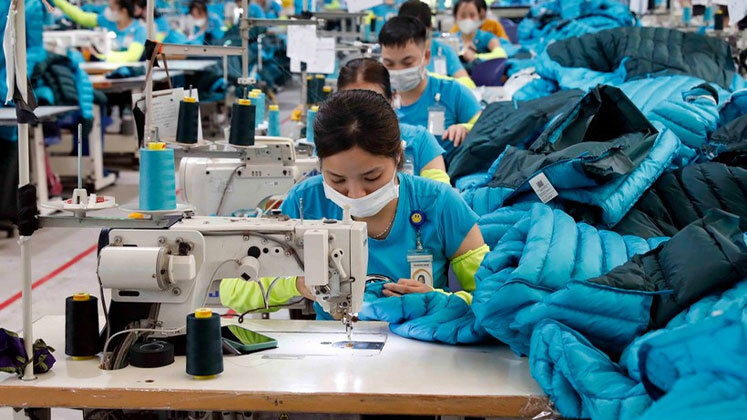
Canada has continued to stand out as a resilient growth market for Vietnam’s textile and garment exports despite ongoing global tariff pressures, with export value estimated to have risen by around 10% in 2025 to more than US $ 1.3 billion. Industry observers attribute this performance largely to advantages under the Comprehensive and Progressive Agreement for Trans-Pacific Partnership (CPTPP), competitive product quality and Canada’s efforts to diversify sourcing away from traditional suppliers.
Vietnamese textile manufacturers attracted strong interest from Canadian and North American buyers at the international textile and apparel exhibition held in Toronto in 2025. Products showcased by Bao Minh Textile JSC and Viet Hong Textile Dyeing JSC drew particular attention. Viet Hong presented its core denim fabric offerings, while Bao Minh highlighted its mid- to high-end yarn and fabric products manufactured through a fully integrated production chain.
Bob Kirke, Executive Director of the Canadian Apparel Federation, said Vietnamese textile and apparel products were widely recognised for their quality, although competition in the market remained intense. He noted that Canada was not a large consumer market and that many Vietnamese-made products currently entered the country through international brands rather than direct sourcing. He added that the federation was keen to encourage direct partnerships between Canadian and Vietnamese firms, emphasising that a targeted approach towards selected Canadian companies would be critical for Vietnamese exporters seeking deeper market penetration.
Viet Hong’s Sales Director, Romeo M. Ordas, said the company sourced cotton from Vietnam, Brazil and Australia, all CPTPP member countries, ensuring eligibility for preferential tariffs under the agreement. He said the company currently operates with a production capacity of 1.2 million metres per month and plans to expand this to 2 million metres in response to growing export demand. He added that Viet Hong had completed preparations to expand further into the Canadian market with the objective of securing a larger market share.
For Bao Minh Textile, the Toronto exhibition marked its first effort to explore opportunities in Canada, following previous export experience in the United States. The company specialises in woven fabrics and operates a closed-loop production system, from yarn spinning to finished fabric, allowing it to fully benefit from CPTPP tariff preferences. Bao Minh is positioning itself in the mid- and high-end segments, with a strong emphasis on quality to meet Canada’s stringent technical and compliance requirements.
Following the implementation of CPTPP, Vietnam’s textile and garment exports to Canada doubled from US $ 600 million to US $ 1.2 billion in 2024, with export values remaining stable thereafter due to consistent quality and regulatory compliance.
Vietnam’s Trade Counsellor in Canada, Tran Thu Quynh, said the country has long been regarded as a reliable supplier of high-standard textile and apparel products capable of meeting demanding technical requirements. She added that a growing number of Canadian investors were establishing manufacturing operations in Vietnam, not only to supply North American markets but also to use Vietnam as a regional hub for distribution across the Asia-Pacific and global markets.